We are aware that taking the Saviynt SAVIGA-C01 certification exam may be quite expensive. To save you money, we provide you with up to 1 year of free SAVIGA-C01 exam questions updates. Moreover, you can check out the features of our PracticeMaterial's SAVIGA-C01 practice exam material by downloading a free demo. We provide you with a Free SAVIGA-C01 Exam Questions demo to assist you in making a decision that is well-informed. We are sure that by preparing with updated our Saviynt SAVIGA-C01 exam questions you can get success and save both time and money.
| Topic | Details |
|---|---|
| Topic 1 |
|
| Topic 2 |
|
| Topic 3 |
|
| Topic 4 |
|
| Topic 5 |
|
| Topic 6 |
|
| Topic 7 |
|
| Topic 8 |
|
| Topic 9 |
|
| Topic 10 |
|
| Topic 11 |
|
>> Saviynt SAVIGA-C01 Reliable Exam Preparation <<
Our SAVIGA-C01 study materials boost the self-learning and self-evaluation functions so as to let the clients understand their learning results and learning process , then find the weak links to improve them. Through the self-learning function the learners can choose the learning methods by themselves and choose the contents which they think are important. Through the self-evaluation function the learners can evaluate their mastery degree of our SAVIGA-C01 Study Materials and their learning process. The two functions can help the learners adjust their learning arrangements and schedules to efficiently prepare the exam.
NEW QUESTION # 53
________ filters the requestable applications under "Request New Access."
Answer: B
Explanation:
The component that filters the requestable applications under "Request New Access" in Saviynt is the Access Query. Here's a detailed explanation:
* Saviynt's Access Request System (ARS): As the front end for requesting access, the ARS needs a mechanism to determine which applications (and entitlements) should be displayed to a user as requestable.
* Access Query: This is a powerful feature within Saviynt that allows administrators to define specific criteria to control the visibility of applications and entitlements in the ARS. Think of it as a filter that determines what a user can see and request.
* How Access Queries Work:
* Defined on Applications/Entitlements: Access Queries are configured on individual applications or entitlements within Saviynt.
* Based on User Attributes: They use user attributes (e.g., department, location, job title, group memberships) and other criteria (e.g., risk level) to determine if a user should see a particular application or entitlement.
* Dynamic Filtering: When a user accesses the "Request New Access" section, Saviynt evaluates the Access Queries associated with each application and entitlement in real-time. Based on the user's attributes, the system dynamically filters the list, showing only the applications and entitlements that match the query conditions.
* Saviynt's Security Model: Access Queries are a fundamental part of Saviynt's security model. They ensure that users are only presented with access options that are relevant and appropriate for their role and context, preventing accidental over-provisioning and reducing the attack surface.
* Other Options:
* Access Add Workflow: While essential for processing access requests, the workflow itself doesn't filter which applications are initially displayed.
* Provisioning Connection: This relates to how Saviynt connects to target systems for automated provisioning. It doesn't control the initial visibility of applications in the ARS.
* Whom to Request: This setting might determine the available approvers, but it doesn't filter the list of requestable applications.
In essence: Access Queries act as a dynamic filter, leveraging user attributes and defined criteria to determine which applications and entitlements are presented to a user within Saviynt's "Request New Access" interface, ensuring a personalized and secure access request experience.
NEW QUESTION # 54
ABC Company intends to implement a workflow that involves Saviynt User Group's approval. Which of the following Workflow blocks is appropriate for this implementation?
Answer: C
Explanation:
To implement a workflow involving a Saviynt User Group's approval, the appropriate workflow block is B.
TASK Access Approve. Here's an explanation:
* Saviynt's Workflow Engine: Saviynt's workflow engine allows for the creation of complex approval processes using various building blocks or activities.
* TASK Access Approve: This specific activity is designed to handle approval steps within a workflow.
It allows you to define who the approver(s) should be and how the approval should be processed.
* User Group Approval: To implement approval by a Saviynt User Group, you would configure the
"TASK Access Approve" activity as follows:
* Approver Type: You would select "User Group" as the approver type.
* User Group Selection: You would then specify the particular Saviynt User Group that should be responsible for the approval.
* Approval Logic: You can define whether all members of the group must approve, or if a certain number or percentage of approvals is sufficient.
* Saviynt User Groups: User Groups in Saviynt are collections of users, often based on department, role, or other criteria. They are useful for managing access and approvals at a group level.
* Other Options:
* A. CONDITION IF Else: This block is used for branching logic in a workflow, not specifically for assigning approvals to user groups.
* C. Action Prompt: This might be used for displaying information or collecting input, but not for defining an approval step.
* D. TASK Custom Assignment: While you could potentially use custom assignment with scripting to achieve user group approval, the "TASK Access Approve" activity provides a more straightforward and built-in way to do it.
In conclusion: The "TASK Access Approve" workflow block in Saviynt, configured with a User Group as the approver type, is the most appropriate and direct way to implement a workflow that requires approval from a specific Saviynt User Group.
NEW QUESTION # 55
The Sales department of a company requires an approval workflow to be created for an application where the Manager's approval should be followed by the Application Owner's approval. Which of the following sequences form the correct order of the workflow events?
Answer: A
Explanation:
The correct sequence of workflow events for an application where the Manager's approval should be followed by the Application Owner's approval is D. Start > Manager's Approval > Resource Owner's Approval > Approve/Reject > End. Here's a breakdown:
* Saviynt's Workflow Structure: Saviynt workflows follow a sequential structure, starting with a
"Start" event and ending with an "End" event.
* Workflow Activities: Each step in the workflow is represented by an activity, such as an approval task.
* Manager's Approval: In this scenario, the first required approval is from the Manager. This would be represented by a "TASK Access Approve" activity (or similar, depending on the specific configuration) assigned to the user's manager.
* Application Owner's Approval: After the Manager's approval, the workflow needs to proceed to the Application Owner for their approval. This would be another "TASK Access Approve" activity assigned to the Application Owner. In Saviynt terms, Application Owner is a type of Resource Owner.
* Approve/Reject: This activity represents the decision point where the final approver (in this case, the Application Owner) either approves or rejects the request.
* End: The workflow concludes with the "End" event, signifying the completion of the process.
* Other Options:
* A. Start > Resource Owner's Approval > Manager's Approval > Approve/Reject > End:
Incorrect order; the manager's approval should come before the application owner's.
* B. Start > Manager's Approval > Custom Assignment > Approve/Reject > End: "Custom Assignment" is not the most appropriate activity for a standard approval step. "TASK Access Approve" would be more suitable.
* C. Start > Manager's Approval > Access Approval > Approve/Reject > End: "Access Approval" is a bit redundant; "TASK Access Approve" assigned to the appropriate role is clearer.
In essence: The correct workflow sequence accurately reflects the required approval hierarchy: first the Manager, then the Application Owner, followed by the final decision (Approve/Reject) and the end of the workflow.
NEW QUESTION # 56
Match the following SoD Violations status with their description.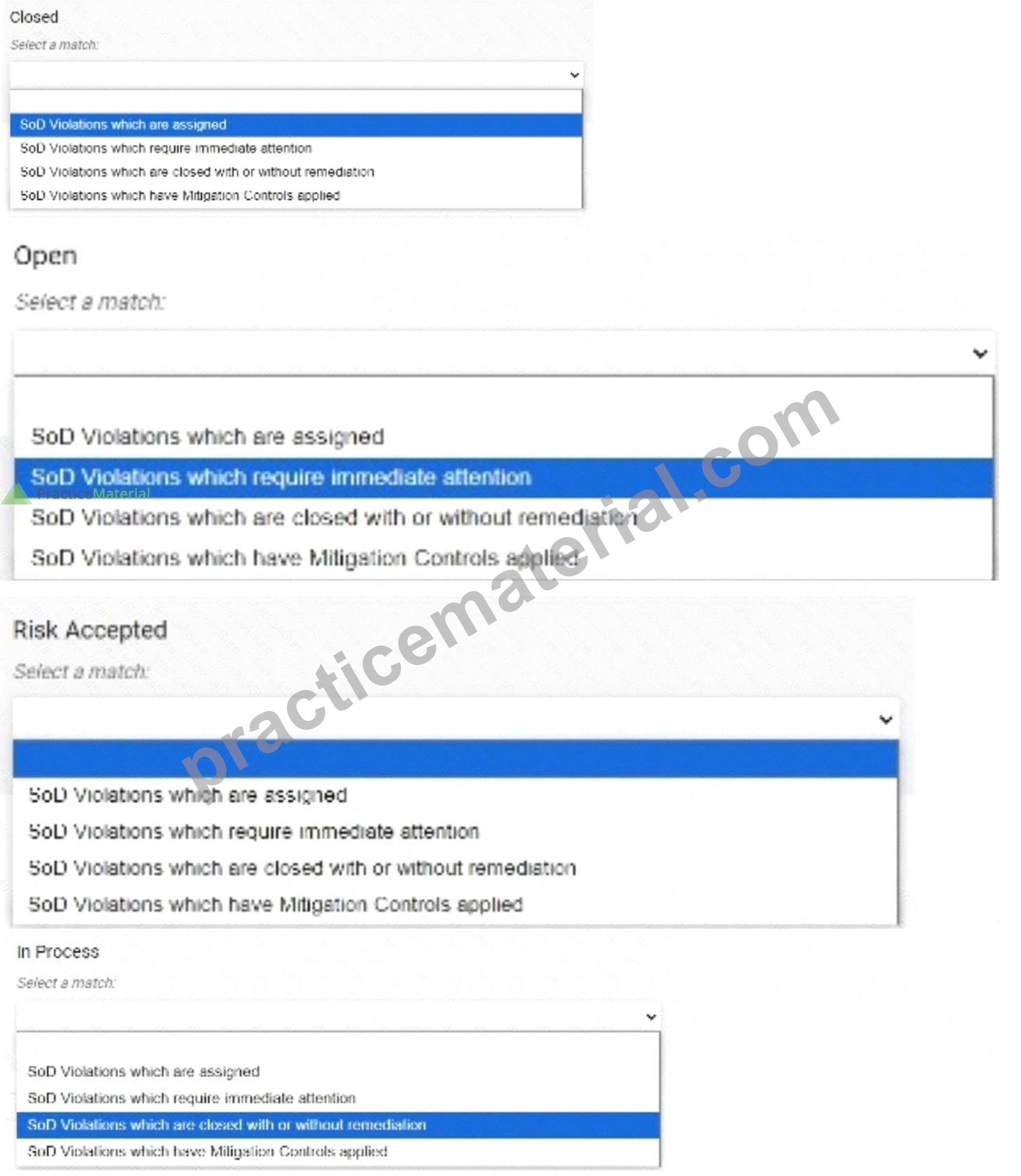
Answer:
Explanation: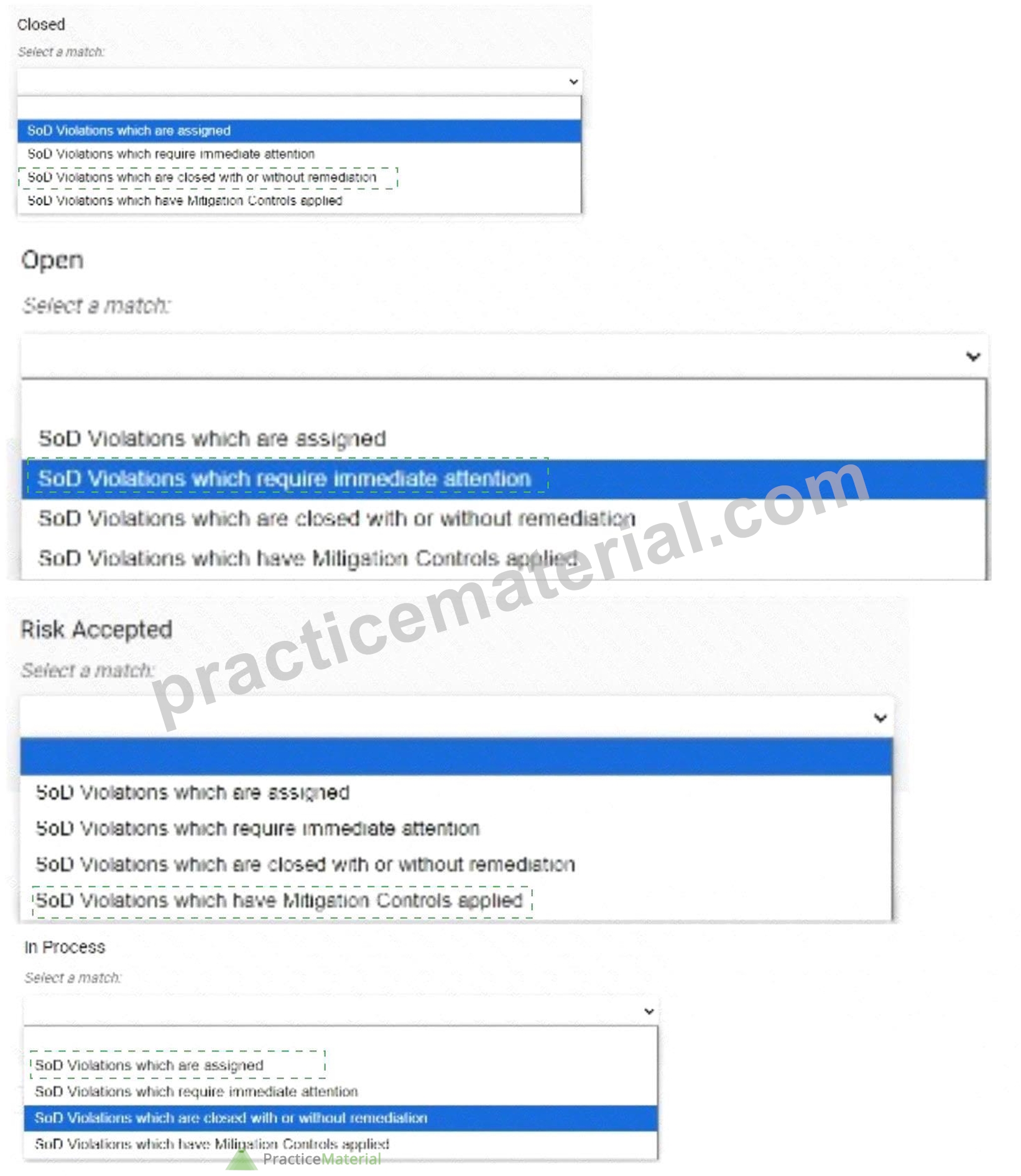
Explanation:
* Closed: SoD Violations which are closed with or without remediation
* Open: SoD Violations which require immediate attention
* Risk Accepted: SoD Violations which have Mitigation Controls applied
* In Process: SoD Violations which are assigned
* Closed: This status implies that the SoD violation has been addressed. It could have been resolved through remediation (e.g., removing conflicting access) or through acceptance after a review process (without direct remediation, perhaps mitigated in another way).
* Open: This status indicates that the SoD violation is active and needs immediate attention to mitigate the associated risk.
* Risk Accepted: This status suggests that the SoD violation has been acknowledged, but instead of being fully remediated, mitigation controls have been put in place to reduce the risk to an acceptable level. This usually follows a formal risk acceptance process.
* In Process: This status means that the SoD violation is currently being worked on. It has likely been assigned to someone for investigation, remediation, or further action.
Therefore, the matches you've made in the image are accurate and reflect standard SoD management practices.
NEW QUESTION # 57
Which of the following actions is appropriate if the data displayed in the Campaign Preview mode does not meet the requirement?
Answer: D
Explanation:
If the data displayed in the Campaign Preview mode does not meet the requirement in Saviynt, the appropriate action is A. Re-configure Campaign. Here's why:
* Saviynt's Campaign Preview Mode: This mode allows administrators to review the data that will be included in a campaign before activating it. It's a crucial step for ensuring that the campaign scope, data, and configuration are correct.
* Purpose of Preview Mode: The primary purpose of the preview is to identify any issues or discrepancies in the campaign setup before it goes live.
* Re-configure Campaign: If the preview reveals problems (e.g., incorrect users or entitlements are included, the wrong Certifiers are assigned, filters are not working as expected), the administrator needs to go back and re-configure the campaign settings. This might involve:
* Adjusting the campaign scope.
* Modifying filters or selection criteria.
* Changing Certifier assignments.
* Updating the campaign schedule or notifications.
* Why Other Options Are Incorrect:
* B. Check Summary: The summary provides a high-level overview of the campaign, but it doesn't allow for detailed data review like the preview mode.
* C. Export Campaign: Exporting the campaign data won't fix the underlying configuration issues.
* D. Activate Campaign: Activating a campaign with incorrect data would lead to inaccurate certification decisions and potential security risks.
NEW QUESTION # 58
......
Preparation for the professional Saviynt IGA Certified Professional Exam (L100) (SAVIGA-C01) exam is no more difficult because experts have introduced the preparatory products. With PracticeMaterial products, you can pass the Saviynt SAVIGA-C01 Exam on the first attempt. If you want a promotion or leave your current job, you should consider achieving a professional certification like Saviynt IGA Certified Professional Exam (L100) (SAVIGA-C01) exam.
SAVIGA-C01 Reliable Test Preparation: https://www.practicematerial.com/SAVIGA-C01-exam-materials.html
