BONUS!!! Download part of FreeCram JN0-664 dumps for free: https://drive.google.com/open?id=1MT-SAEfX9kVUP08Wy2jlDVa8VA3j0j1k
If you would like to use all kinds of electronic devices to prepare for the JN0-664 JN0-664 exam, then I am glad to tell you that our online app version is definitely your perfect choice. In addition, another strong point of the online app version is that it is convenient for you to use even though you are in offline environment. In other words, you can prepare for your JN0-664 Exam with under the guidance of our training materials anywhere at any time. Just take action to purchase we would be pleased to make you the next beneficiary of our JN0-664 exam practice.
The JN0-664 exam covers a wide range of topics, including Junos OS fundamentals, routing protocols, network security, MPLS, QoS, and more. Candidates must have a deep understanding of these topics and practical experience in configuring and troubleshooting Juniper Networks service provider networks. Passing JN0-664 exam demonstrates that a candidate has the necessary skills and knowledge to design, implement, and troubleshoot complex service provider networks using Juniper Networks technology.
The JNCIP-SP exam tests the candidate’s knowledge in various areas such as OSPF, IS-IS, BGP, MPLS, Layer 2 VPNs, Layer 3 VPNs, and multicast. The candidate must have hands-on experience in these areas to pass the exam. JN0-664 Exam is a combination of multiple-choice questions, drag-and-drop questions, and simulation-based questions.
To pass the Juniper JN0-664 certification exam, candidates must have a solid understanding of advanced networking concepts, including routing policies, BGP route manipulation, MPLS VPNs, multicast routing, and Class of Service (CoS) implementation. They must also understand the operation and configuration of Juniper Networks networking devices, such as the MX Series 3D Universal Edge Router, EX Series Ethernet Switches, and SRX Series Services Gateways.
>> Juniper JN0-664 Lead2pass Review <<
In order to protect the vital interests of each IT certification exams candidate, FreeCram provides high-quality Juniper JN0-664 Exam Training materials. This exam material is specially developed according to the needs of the candidates. It is researched by the IT experts of FreeCram. Their struggle is not just to help you pass the exam, but also in order to let you have a better tomorrow.
NEW QUESTION # 76
When using OSPFv3 for an IPv4 environment, which statement is correct?
Answer: A
Explanation:
Explanation
OSPFv3 is an extension of OSPFv2 that supports IPv6 routing and addressing. OSPFv3 is not backward compatible with IPv4 because it uses a different packet format and a different link-state advertisement (LSA) structure than OSPFv2. OSPFv3 also uses IPv6 link-local addresses as router IDs and neighbor addresses, instead of IPv4 addresses. To use OSPFv3 for an IPv4 environment, you need to enable the IPv4 unicast address family under [edit protocols ospf3] hierarchy level and configure IPv4 addresses on the interfaces.
NEW QUESTION # 77
Exhibit
You are troubleshooting the connection between AS 64496 and AS 64497 and notice that only one of the paths is being used for traffic forwarding.
Referring to the exhibit, which three actions will ensure that R1 is configured properly for load balancing BGP routes? (Choose three.)
Answer: B,C,E
NEW QUESTION # 78
Exhibit.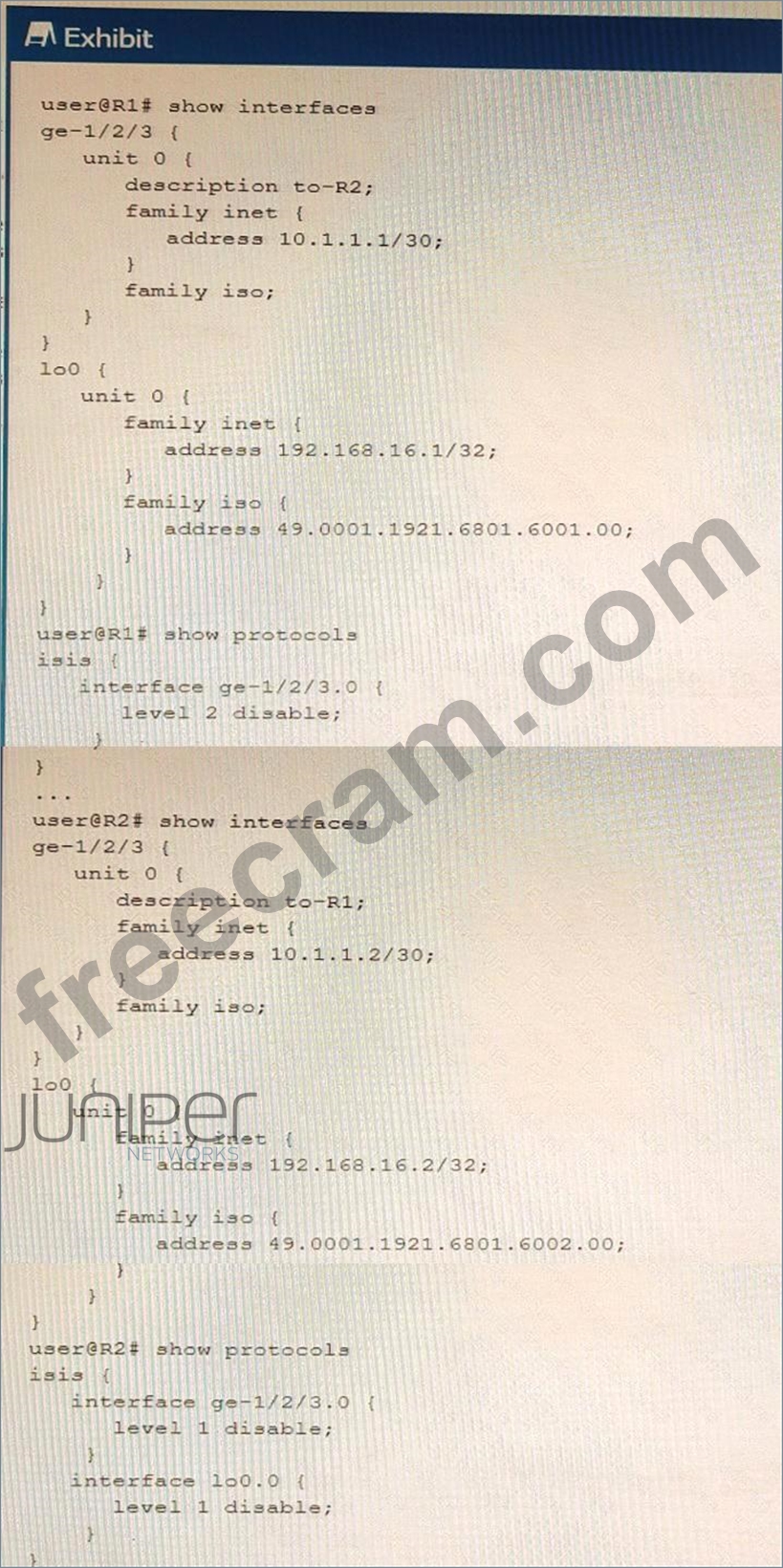
Referring to the exhib.t, what must be changed to establish a Level 1 adjacency between routers R1 and R2?
Answer: D
Explanation:
IS-IS routers can form Level 1 or Level 2 adjacencies depending on their configuration and network topology.
Level 1 routers are intra-area routers that share the same area address with their neighbors. Level 2 routers are inter-area routers that can connect different areas. Level 1-2 routers are both intra-area and inter-area routers that can form adjacencies with any other router.
In the exhibit, R1 and R2 are in different areas (49.0001 and 49.0002), so they cannot form a Level 1 adjacency. However, they can form a Level 2 adjacency if they are both configured as Level 1-2 routers. R1 is already configured as a Level 1-2 router, but R2 is configured as a Level 1 router only, because of the level 1 disable command under the lo0.0 interface. This command disables Level 2 routing on the loopback interface, which is used as the router ID for IS-IS.
Therefore, to establish a Level 1 adjacency between R1 and R2, the level 1 disable command under the R2 protocols isis interface lo0.0 hierarchy must be removed. This will enable Level 2 routing on R2 and allow it to form a Level 2 adjacency with R1.
NEW QUESTION # 79
Exhibit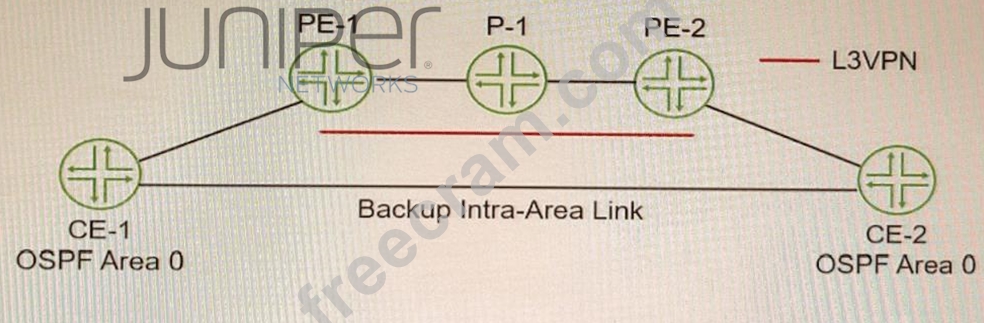
You must ensure that the VPN backbone is preferred over the back door intra-area link as long as the VPN is available. Referring to the exhibit, which action will accomplish this task?
Answer: C
Explanation:
A sham link is a logical link between two PE routers that belong to the same OSPF area but are connected through an L3VPN. A sham link makes the PE routers appear as if they are directly connected, and prevents OSPF from preferring an intra-area back door link over the VPN backbone. To create a sham link, you need to configure the local and remote addresses of the PE routers under the [edit protocols ospf area area-id] hierarchy level1.
https://www.juniper.net/documentation/us/en/software/junos/ospf/topics/topic-map/configuring-ospfv2-sham- links.html
NEW QUESTION # 80
You are configuring schedulers to define the class-of-service properties of output queues. You want to control packet drops during periods of congestion.
In this scenario, which CoS configuration parameter would be used to accomplish this task?
Answer: C
Explanation:
When configuring Class of Service (CoS) properties for output queues, we need to manage packet drops during periods of congestion. Juniper's CoS framework provides several tools to manage congestion, including drop profiles, buffer sizes, and scheduling mechanisms. Let's break down each option and identify the correct one.
Evaluating the Answer Choices
✅ D. drop profile (Correct Answer)
Why?
A drop profile defines when packets should be dropped based on the queue fill level.
Random Early Detection (RED) or Tail Drop can be used to manage congestion by discarding lower-priority packets first.
Drop profiles are configured under the scheduler to determine how aggressive packet dropping should be during congestion.
Example Juniper Configuration:
schedulers {
best-effort {
drop-profile low-drop;
}
}
drop-profiles {
low-drop {
fill-level 80 drop-probability 50;
}
}
fill-level 80 → When the queue reaches 80% full, packet drops begin.
drop-probability 50 → There is a 50% chance of dropping packets once the threshold is reached.
Official Juniper Documentation Reference:
Junos Class of Service Configuration Guide
"A drop profile determines how packets are discarded based on the queue fill level, allowing control over congestion behavior." Why the Other Options Are Incorrect?
❌ A. buffer size (Incorrect)
Why?
The buffer size determines how many packets the queue can store before congestion occurs.
A larger buffer can delay drops, but it does not actively control dropping behavior.
It affects latency rather than controlling packet drops.
❌ B. priority (Incorrect)
Why?
Priority controls which queue gets serviced first, not how drops are handled.
Higher priority queues are serviced before lower-priority queues, but this does not prevent congestion-related drops.
❌ C. shaping rate (Incorrect)
Why?
Shaping limits the maximum transmission rate of the queue.
While shaping helps reduce congestion, it does not control which packets get dropped during congestion.
Shaping is useful for traffic smoothing, but it does not actively drop packets based on queue fill levels.
Final answer: ✅ D. drop profile
Controls packet drops based on queue congestion.
Defines RED (Random Early Detection) or Tail Drop mechanisms.
Directly influences drop probability as the queue fills up.
Official Juniper Reference:
"Drop profiles are used to manage congestion by determining when and how aggressively packets are dropped based on queue fill level."
NEW QUESTION # 81
......
As we all know, the examination fees about JN0-664 exam test is too expensive, so many IT candidates want to get the most valid and useful JN0-664 study material and expect to pass the actual test at first attempt. FreeCram provide you with the latest JN0-664 exam prep study material which can ensure you 100% pass. The quality & service of JN0-664 exam dumps will give you a good shopping experience. The quality and quantities are controlled by strict standards. FreeCram has IT experts handling the latest IT information so as to adjust the outline for the exam dumps at the first time, thus to ensure the Juniper JN0-664 training exam cram shown front of you is the latest and most relevant.
JN0-664 Exam Exercise: https://www.freecram.com/Juniper-certification/JN0-664-exam-dumps.html
BONUS!!! Download part of FreeCram JN0-664 dumps for free: https://drive.google.com/open?id=1MT-SAEfX9kVUP08Wy2jlDVa8VA3j0j1k
